Welcome to Cyber Hygiene, my weekly newsletter, where I share tips and actionable data to help everyone stay safe online.
🔍 What Are Employment Scams?
Employment scams are fraudulent schemes that trick people with the promise of a job, income, or work-related opportunity. Instead of delivering real employment, scammers use fake offers to steal money, personal data, or both.
They come in many forms, including:
Fake Job Offers / Recruitment Scams: impostors posing as recruiters or HR managers.
Work-From-Home Schemes: roles that require you to buy “kits” or “training.”
Task-Based Jobs: micro-tasks like liking posts or writing reviews, where victims are later pressured to invest money.
Fake Check & Overpayment Scams: victims are “paid” with counterfeit checks and asked to return part of the money.
Pyramid / MLM Disguises: recruitment-heavy schemes marketed as legitimate work.
👉 Bottom line: If a job offer asks for money upfront, promises unrealistic pay, or pressures you to share sensitive information, it’s likely an employment scam.
⚠️ Why They’re Dangerous
Employment scams aren’t just about losing a fake job. They can cause lasting financial, personal, and emotional damage:
💸 Financial Losses
Victims pay for “training,” “equipment,” or get tricked into refunding fake overpayments.
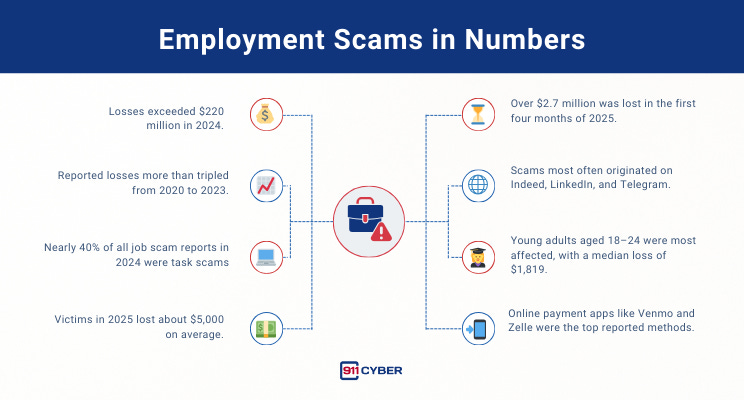
Average reported losses are nearly $5,000 per victim in recent cases.
🪪 Identity Theft
Resumés and on-boarding forms contain sensitive data (SSN, DOB, address, banking info).
Once stolen, this data is sold or used to open fraudulent accounts.
💔 Emotional Toll
Victims invest hope in a “dream job” only to face betrayal.
Shame and fear of judgment often stop people from reporting.
🌐 Reputational Damage
Scammers may impersonate real employers or even trick victims into unknowingly helping launder money.
A victim’s name can get linked to fraudulent activity.
⏳ Long-Term Risk
Unlike one-time scams, stolen identity or bank info can resurface months or years later.
👉 Bottom line: Employment scams target both your wallet and your identity, making them one of the most personally damaging forms of fraud today.
🚩 Key Tactics Scammers Use Today
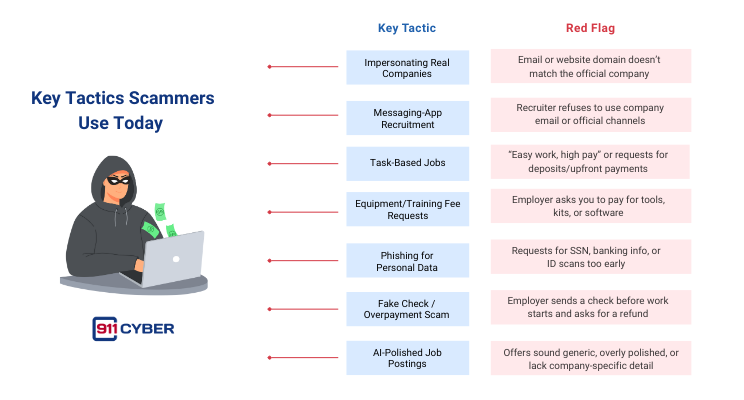
Fake job offers aren’t random.They follow well-tested playbooks designed to pressure, flatter, or confuse job seekers into handing over money or personal data.
⚙️ How Each Tactic Works
Impersonating Real Companies
Scammers clone career pages, LinkedIn profiles, or emails from well-known brands to appear legitimate. Job seekers may receive professional-looking offer letters or on-boarding forms, but the employer is fake.
Messaging-App Recruitment
Fraudsters initiate contact via SMS, WhatsApp, or Telegram, bypassing official company channels. This creates urgency and informality, which lowers skepticism and makes job seekers more vulnerable.
Task-Based Jobs
Victims are offered small “tasks” like liking posts, testing apps, or completing surveys. Initial small payments are used to build trust, then they are pressured to invest their own money or recruit others.
Equipment/Training Fee Requests
Scammers claim you need to buy training materials, software, or work-from-home kits upfront. Once paid, the “employer” disappears and the victim loses the money.
Phishing for Personal Data
Fake on-boarding forms ask for sensitive information like Social Security numbers, bank accounts, or scanned IDs. This data can be used to commit identity theft or open fraudulent accounts.
Fake Check / Overpayment Scam
Victims receive counterfeit checks for work they didn’t do and are asked to refund the “overpaid” portion. By the time the bank reverses the fake check, the refund is gone.
AI-Polished Job Postings
Using AI tools, scammers generate professional-sounding job postings, emails, and interview scripts. This makes fake offers more convincing and harder to detect, even for experienced job seekers.
🤖 How AI is Making Things Worse
AI is making employment scams more convincing and harder to detect. Scammers can now generate professional-looking job ads, fake recruiter emails, and polished interview scripts in minutes, making fake offers appear legitimate. Deepfake voices and AI-generated profiles add another layer of realism, tricking even cautious job seekers into believing they’re interacting with a real company.
At the same time, AI tools are being used to automate the targeting process, scanning LinkedIn, resumes, and social media to find high-value victims. This means scams are not only more sophisticated but also more widespread, reaching job seekers faster and at scale. Even seasoned professionals can fall prey if they’re not vigilant.
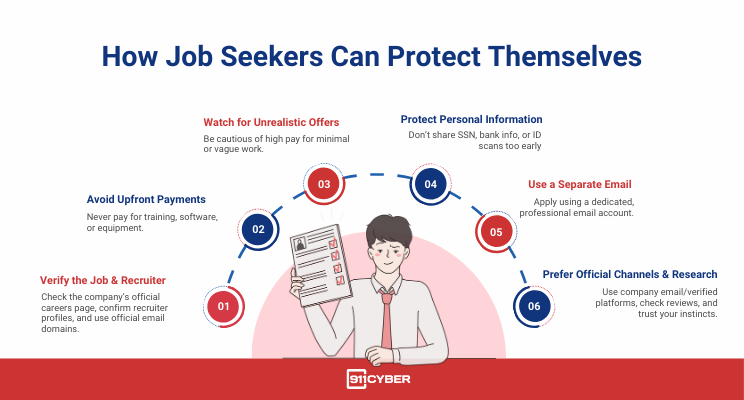
🛡️ How Job Seekers Can Protect Themselves
🧰 What Resources Are Available to Help?
📚Books
Anatomy of an Employment Scam (2024) by Thomas Mitchell
Are You Being Scammed? (2024) by Michael Morin
Home Job Scam Guide: A Comprehensive Guide to Identifying, Avoiding, and Protecting Yourself from Remote Work Fraud (2024) by Majeed Memon
Job Scammers (2022) by Antonio J Higgins and DT xyme
🎙️ Podcasts
Exposing Job Scams and Fake Job Offers: Protect Yourself in the Digital Era by Dana Lynch
Beware of Job Scams by Mike Wood and guest Talia Edmondson
🧠 Final Thoughts
Employment scams are not just abstract statistics. They are real, destructive experiences that can affect anyone, from recent graduates to seasoned professionals. As scammers grow more sophisticated, using AI, fake company websites, and messaging apps, the line between legitimate opportunities and fraud becomes increasingly blurred. Understanding the tactics and red flags is no longer optional. It is essential for protecting both your finances and your identity.
Vigilance is your first line of defense. Always verify job postings, research recruiters, and never hand over personal information or money upfront. Small steps, like using separate email accounts for applications, double-checking official company channels, and trusting your instincts, can make the difference between a safe job search and a costly mistake.
Knowledge is power. Sharing your awareness with friends, colleagues, and your network can prevent others from falling victim. Employment scams thrive in secrecy and speed, but with awareness, preparation, and careful verification, job seekers can reclaim control of their search and pursue real opportunities safely.
